Pages

Subscribe:

Sabtu, 12 September 2015

Rare ancient sarcophagus discovered in Israel


An elaborate ancient sarcophagus has been discovered at a building site in the Israeli city of Ashkelon, the Israel Antiquities Authority announced Thursday.
However, the sarcophagus, which is around 1,800 years old, was severely damaged when building contractors attempted to remove it improperly from the ground, according to officials.
The Israel Antiquities Authority said that it will take legal action against those involved.
Described as one of the rarest sarcophagi ever discovered in Israel, the stone coffin weighs 2 tons and is 8.2 feet long. Sculpted on all sides, a life-size figure of a person is sculpted on the sarcophagus’ lid.
“One side of the sarcophagus lid is adorned with the carved image of a man leaning on his left arm,” explained Gabi Mazor, a retired archaeologist and expert on the classical periods, in an Israel Antiquities Authority press release. “He is wearing a short-sleeved shirt decorated with embroidery on the front. A tunic is wrapped around his waist. The figure’s eyes were apparently inlaid with precious stones that have disappeared and the hair is arranged in curls, in a typical Roman hairstyle.”
The other side of the lid features a carved relief of a metal amphora, a vessel used for transporting liquids such as wine, from which there are intertwining tendrils bearing grape clusters and grape leaves. The sarcophagus is also decorated with wreaths and images of bulls' heads, naked Cupids, and the head of the mythical creature Medusa.
The sarcophagus, which was apparently excavated last week, was repeatedly struck by a tractor in different places, scarring the stone and damaging the decorations sculpted by on its sides, according to the press release.
“The irreparable damage was caused by contractors who encountered the impressive sarcophagus during the course of their work,” officials explained. “They decided to hide it, pulled it out of the ground with a tractor while aggressively damaging it, concealed it beneath a stack of sheet metal and boards and poured a concrete floor in the lot so as to conceal any evidence of the existence of the antiquities site.”

Mass grave of new human relative discovered in South Africa, claim scientists

Scientists in South Africa working at Moropeng, the site located just outside of Johannesburg and known as the "Cradle of Humankind," have discovered a mass underground grave containing the remains of hundreds of individuals from what they say is an entirely new species of the human family.
“I give you a new species of human - ‘homo naledi,’” said Professor Lee Berger, head of the paleontology team at University of the Witwatersrand in Johannesburg, and leader of the discovery team. 
The species' brains were a third of the size of today’s humans but they stood like us, and had similar feet and hands, although their fingers were elegantly curved. This new species, Berger said, should be placed as an early humanoid just before the time of homo sapiens. The species could date back as far as 2.8 million years, according to experts.

Jumat, 11 September 2015

European astronaut uses 'the Force' to control rover from space


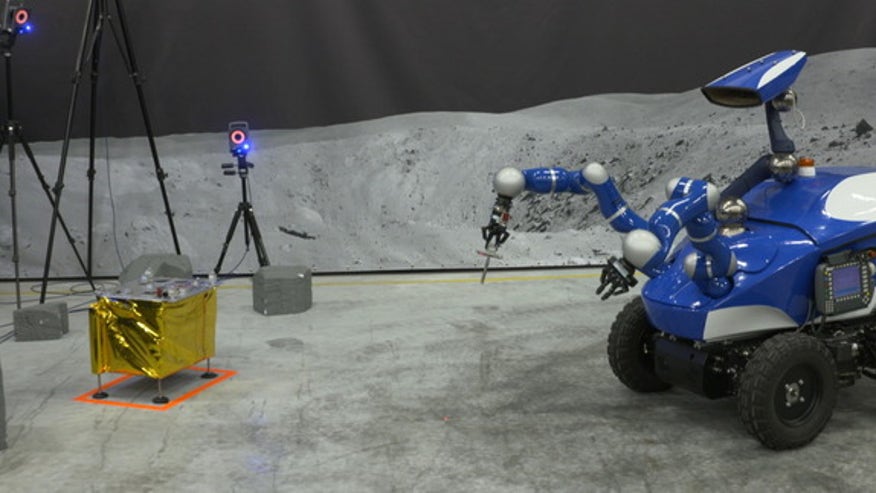
Demonstrating one small step for rover operations, a European astronaut successfully maneuvered a machine on Earth in precision operations from his perch 248 miles high on the International Space Station.
Sept. 7, the European Space Agency (ESA) astronaut Andreas Mogensen helped demonstrate the first "force feedback" using a rover controlled from space. With the help of a system that let him feel forces pressing against the rover's arm, Mogensen remotely inserted a small, round peg into a "task board" that offered just a fraction of a millimeter of clearance.
"Andreas managed two complete drive, approach, park and peg-in-hole insertions, demonstrating precision force-feedback from orbit for the very first time in the history of spaceflight," experiment leader André Schiele of ESA's Telerobotics and Haptics Laboratory said in a statement. [Video: Space-Borne Astronaut Runs Robot On Earth]
"He had never operated the rover before, but its controls turned out to be very intuitive," Schiele said in the statement. "Andreas took 45 minutes to reach the task board and then insert the pin on his first attempt, and less than 10 minutes on his follow-up attempt, showing a very steep learning curve."
Clever engineering allowed the astronaut to "feel" his way around the hole despite there being a 1-second delay between his movements and what was happening on the ground. The team — which included members from the European Space Research and Technology Centre (ESTEC) and graduate students from Delft University of Technology, both in the Netherlands — created software models to compensate for the lag.
The signal from the space station has to pass through several obstacles before reaching ESTEC and the waiting rover. After leaving the station, the signal goes to satellites in geosynchronous orbit roughly 22,300 miles high, beams to a ground station in New Mexico (via NASA's Johnson Space Center) and then travels to ESTEC via a transatlantic cable. 
By the time the signal gets back from the International Space Station, the round-trip is more than 89,000 miles, the equivalent of nearly halfway to the moon.
Besides placing a peg in a hole, Mogensen also evaluated the stiffness of different springs on the joystick to figure out the appropriate sensitivity for the device. 
The experiment, called Interact, is intended to pioneer remote-control operations from space. As astronauts expand exploration across the solar system, someday this technology could be used for lunar bases or exploring Mars, ESA officials added.

Kamis, 10 September 2015

Elon Musk's answer to making Mars more like Earth? Just nuke it


It hasn't even been a week since Stephen Colbert started hosting CBS' The Late Show, and already, he's getting his guests to make some pretty spectacular claims. Oprah may have watched Tom Cruise jump on a couch, but Colbert got Elon Musk to advance a decidedly gasp-worthy theory about how best to make Mars a more hospitable environment for human life. "The fast way is to drop nuclear weapons over the poles," the Tesla, SpaceX, and PayPal founder told Colbert. To which the host responded, "You're a supervillain!"
Or Ironman, but you know, same difference.
Describing Mars as "a fixer upper of a planet," Musk noted that the main problem with our red neighbor is that it's too cold for inhabitation. But, he noted, it can be made to more closely resemble Earth if we just warm it up. "There's the fast way and the slow way," Musk said, with the slow way being the gradual release of greenhouse gasses, which are famous on Earth for causing global warming and climate change.
But the flashier, more exciting way (and let's face it, the more Elon Musk way), is to drop nuclear bombs on the planet, because nothing screams warmth like thermonuclear weapons. Unfortunately, Musk didn't get to elaborate much further on how exactly this plan would pan out, but it's certainly a novel idea. And considering that his last few SpaceX rocket landings have resulted in explosions of their own, maybe Musk can jumpstart this warming process by sending his spacecraft to Mars.
Of course, the viability of such a plan is probably a bit more questionable than say, bringing frozen methane to Mars from neighboring planets or moons, or better yet, bringing cyanobacteria and algae that are capable of producing oxygen to the Red Planet. But then again, many of Musk's ideas have seemed outlandish at first blush, and he's only ever proved the haters wrong.
So keep this Late Show prediction in the back of your minds, folks. We may just be exploding nukes on Mars someday. Better there than here.

Space Station crosses Sun's face in spectacular new photo


An amazing new photo shows the International Space Station crossing the sun's face.
The picture, a composite of five images taken Sept. 6 from Shenandoah National Park in Virginia by NASA photographer Bill Ingalls, captures a "transit" of theInternational Space Station (ISS) across the solar disk.
Such transits don't last very long, because the space station zooms around Earth at more than 17,000 mph — the $100 billion complex completes one lap around our planet once every 90 minutes or so.
Transits can offer more than just aesthetic appeal. For example, in the 18th century, astronomers were able to calculate the distance from the Earth to the sun by carefully observing two transits of Venus across the sun's face (one in 1761 and the other in 1769) from various locations around the globe. And NASA's Kepler space telescope has spotted thousands of potential exoplanets by detecting the tiny brightness dips they cause when crossing in front of their stars from the observatory's perspective.
The ISS is currently staffed by nine space fliers. But three of them — cosmonaut Gennady Padalka, Denmark's Andreas Mogensen and Kazakhstan's Aidyn Aimbetov — will come back to Earth Saturday (Sept. 12), returning the orbiting lab to its normal complement of six crewmembers.

Rabu, 09 September 2015

Excavation of Rome home shows ancient city bigger than thought

Archaeologists have discovered a 6th-century B.C. residence under a palazzo in central Rome, saying that it proves the ancient city was much bigger than previously thought.
Officials said Wednesday that the area on the Quirinale Hill had long been thought to have only been used as a necropolis, with ancient Rome's residential zone further south and centered around the Roman Forum.
But archaeologists excavating a palazzo on the hill said they discovered a well-preserved rectangular home, complete with wooden supports and a roof, proving that the area was also used for residential purposes.
The ANSA news agency quoted excavation chief Mirella Serlorenzi as saying the discovery "means that Rome at the start of the 6th century was much bigger than what we thought and wasn't just centered around the Forum."

Selasa, 08 September 2015

Volcano zone reservoirs could hold huge amounts of gold and silver


The heat is on for prospectors in what could be the next gold rush. According to a recent study in the journal Geothermics, a team of geologists has discovered a mother lode of gold and silver inside super-heated reservoirs within New Zealand’s Taupo Volcanic Zone. Extreme heat from the volcanoes’ magma plumes is heating water, producing acidic underground reservoirs and springs that in turn dissolve the surrounding rock. This then allows the embedded gold and silver to come loose and collect in the water. If successfully drilled, one well could yield as much as $2.7 million in gold a year.
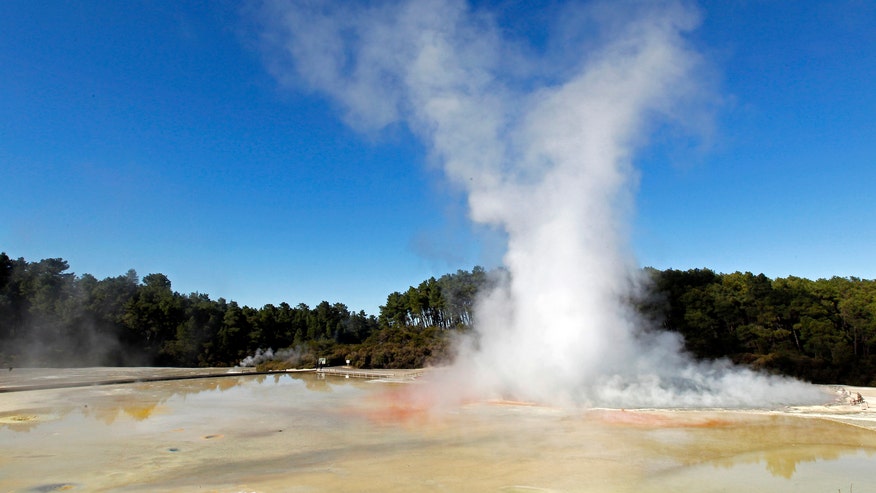
According to lead study author Stuart Simmons, a research professor at the University of Utah’s Energy & Geoscience Institute, gold and silver depositing in hot springs and geothermal wells is nothing new. Apparently this was first discovered over 50 years ago, with New Zealand’s ‘Champagne Pool’ hot spring one of the only places in the world where tourists can actually see this phenomenon happen.
“If you Google ‘Champagne Pool’ online, you will see photos of the striking orange-colored precipitates that deposit around the edge of the pool,” Simmons told FoxNews.com. “Those precipitates are rich in gold, silver, mercury, thallium, arsenic and antimony.”
The road to this new discovery began 15 years ago, when Simmons and a colleague constructed a special device to lower down wells up to 1.8 miles deep, obtaining hot samples of thermal water to determine the concentration of precious minerals.
“After about 5 years, we had some preliminary data on which to make assessments of the amounts of precious metals that might be available,” he recalled. Their work paid off, with the amounts of aqueous gold and silver found in the 18 reservoirs estimated to be tens of thousands of ounces of gold and hundreds of thousands of ounces or more of silver. Now, all they need to do is figure out a way to mine it, which is no easy task considering new equipment would have to be developed that could take the heat (the chloride-rich waters in the underground reservoirs can get as hot as 752 degrees Fahrenheit) and also ensure lasting production.
“It is not really practical to mine gold and silver in a traditional sense inside the geothermal areas,” Simmons said. “Hot boiling water would be encountered in shallow excavations and there would be considerable environmental impact to deal with.”
He explained that there currently isn’t much interest in figuring out ways to mine the minerals since it would disrupt energy production, what with the wells being drilled for steam to power turbines and generate electricity. One solution that was proposed in the study was to mine the reservoirs in intervals after enough gold and silver had accumulated so as to make the disuse of the steam-field worthwhile.
“The more practical thing to do is to attempt to extract the metals from the fluids as they flow through the [existing] surface pipe work,” he said. “The gold and silver are passively accumulating in the shallow parts of the wells and in surface pipe work, so it is not lost.”
So if the new tech is developed, who will reap the financial benefits? Not the researchers who made the discovery – they were in it strictly for the science, according to Simmons.
“The team did the work mainly to get a better understanding of processes of gold and silver deposition in ancient hydrothermal systems that are no longer active but that are host to ore deposits,” he said. “There are many such deposits forming mines and prospects around the Pacific Rim (Japan, Philippines, Indonesia, Papua New Guinea, New Zealand, Chile, Peru, Ecuador, Mexico, and the western US). So the aim was to apply our understanding to new discoveries.”
Simmons worked in conjunction with his colleagues at the University of Auckland, New Zealand on the study.